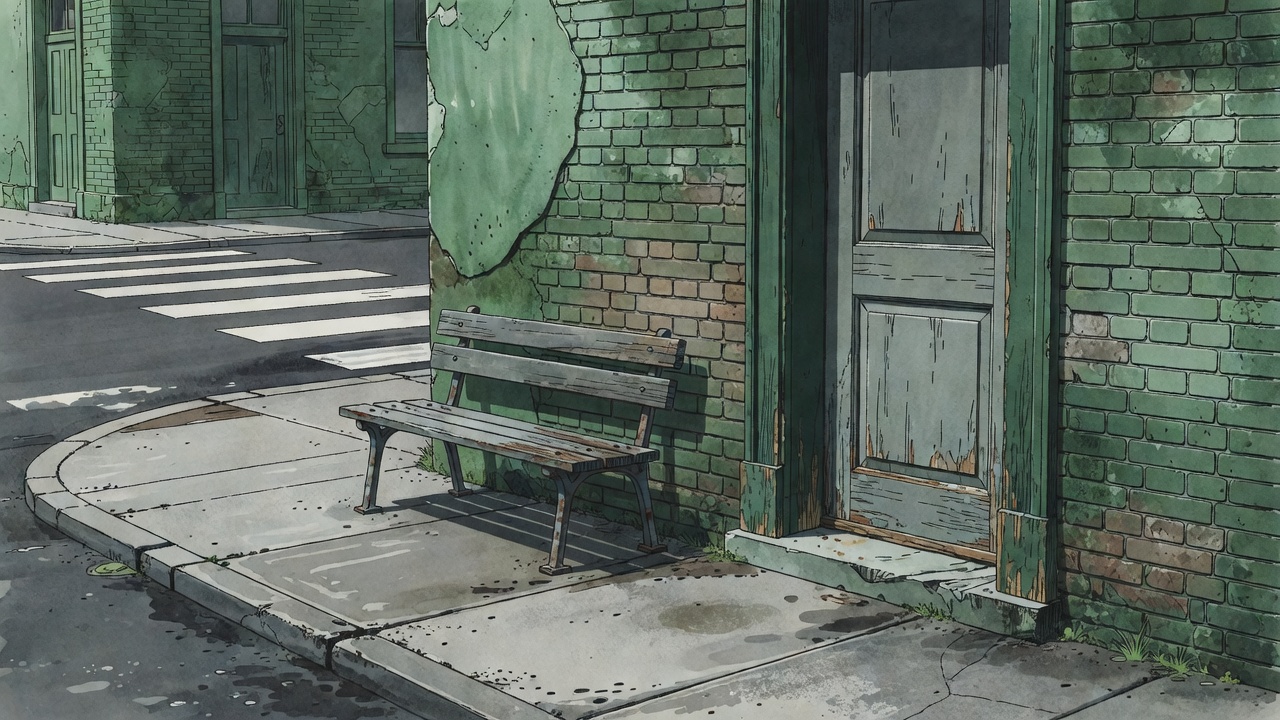
Street-level discovery begins with slowing down rather than getting in. A change in brick colour, an unusually wide doorway or a line of trees can tell you where to ask a question. None of these details, on its own, proves a building’s age or former use. Treat the walk as a first reading: you are collecting visible evidence, not completing a history from the pavement.
Choose a short stretch of public street with safe places to pause. Walk it once without photographing. Notice crossings, entrances, deliveries and other people’s movement. Decide where you can stand without obstructing anyone. If the pavement is narrow, move on and return at a quieter time rather than making other people accommodate your project.
Start with what is physically there
Pick one facade and describe it in plain terms. Count the visible storeys, note the main materials and sketch the relationship between openings. Look for differences rather than decorative labels: a window that does not align with its neighbours, a patched surface, or a ground floor made from a different material. Avoid assigning an architectural style until you have a reason for doing so.
A useful note might read: “The left opening is filled with newer-looking brick; a continuous stone lintel remains above it.” That is stronger than “an old carriage entrance,” unless a reliable source supports the interpretation. The first version preserves an observation that someone else can evaluate. The second can turn an appealing guess into a repeated mistake.
Buildings such as London’s Battersea Power Station and Tate Modern offer well-documented examples of changing use. Their histories can help you think about adaptation, but they are not templates for every altered building. A former shop, workshop or house may have a much less visible history. Check a local listing record or archive before deciding which story fits.
Read the space between buildings
Architecture does not end at the property line. Look at where a crossing meets the pavement, where shade falls and whether seats offer a choice of sun, shelter or back support. Describe the arrangement before judging it. “Three benches face the road and none face the square” is a useful observation; “nobody enjoys this square” is a claim your visit cannot establish.
Notice access without pretending to conduct a professional audit. A dropped kerb may be present while the approach is obstructed. A route may look level but have a difficult surface. Record the visible condition and the limits of your perspective. Do not infer a person’s disability or photograph someone struggling as evidence for your argument.
Jane Jacobs’s The Death and Life of Great American Cities, Kevin Lynch’s The Image of the City and Jan Gehl’s Life Between Buildings offer different ways to think about streets. Use their ideas as questions rather than verdicts. Does an edge feel legible? Where do people have room to stop? What can you see, and what would require longer observation or local knowledge?
Describe the evidence before you name the story.A field-note rule for this guide
Make a note someone else can use
Keep a small, repeatable record: a broad public location, the date and approximate time, the conditions, your observation and your question. Add a photograph only when it improves the record. A rough sketch can explain a doorway or crossing without including faces, vehicle registrations or a view through a private window.
Separate the record into three short lines: “I saw,” “I think” and “I need to check.” This keeps uncertainty visible when you return home. If you later find a source, add its title, creator, date and link rather than silently rewriting the original observation. A correction is part of the work, not a failure of it.
For a caption, begin with the subject and the visible relationship. Explain any necessary context, then state uncertainty. Avoid dramatic claims such as “forgotten” or “untouched” unless you have evidence. A building can be unfamiliar to a visitor while remaining central to the daily life of its neighbours.
Turn one observation into a better walk
Finish by choosing one question to research, not ten more places to collect. You might compare a historic photograph with a present-day view or return to see whether a shaded seat is used differently in another season. Keep your next visit modest and your route flexible. Temporary works, events and residents’ needs take priority over a planned composition.
If you want to exchange a note, remove sensitive details first and explain why the observation matters. Our note builder can help prepare a short, private message; it does not publish anything. For questions about former uses, continue with the local history guide. For the access decision that comes before every photograph, read Explore without intruding.