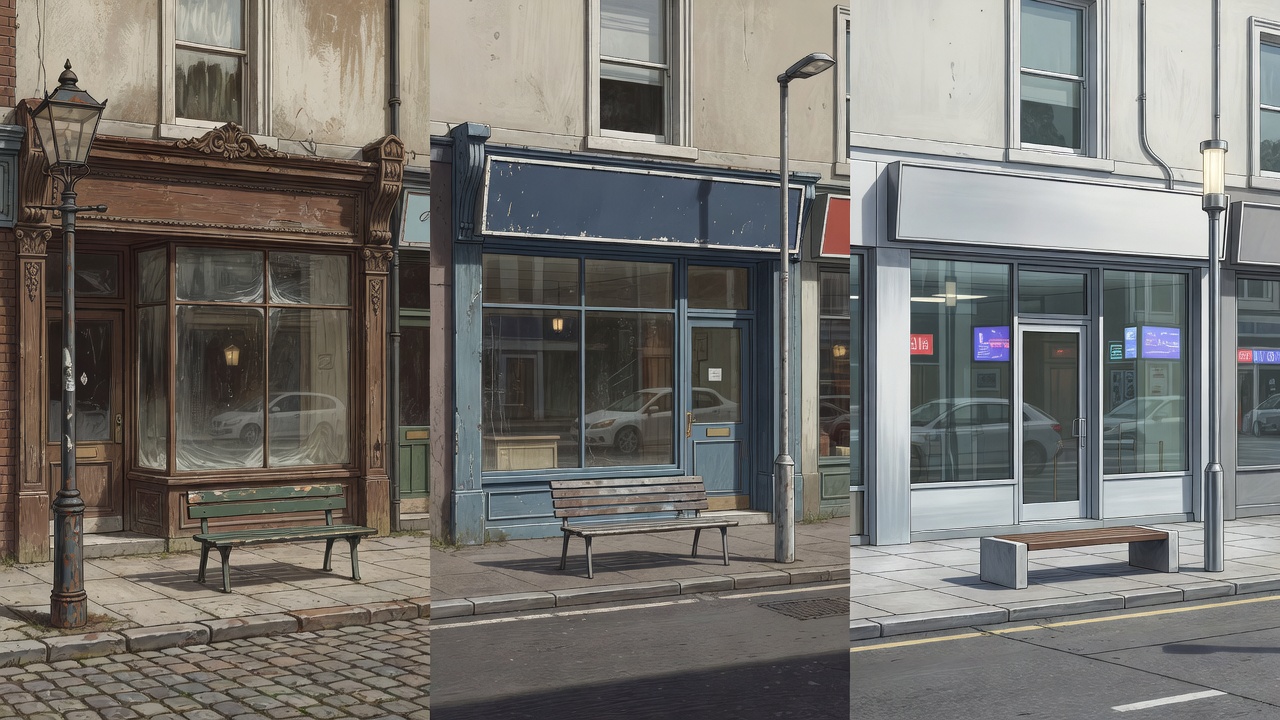
A faded wall sign can start a rewarding investigation. It cannot tell you everything about the people who worked behind it, when the business closed or how neighbours understood the place. Local history becomes more useful when we resist the neat story and keep asking what each source can actually establish.
Begin with one manageable question. “What occupied this corner before the current shop?” is a better first project than “the complete history of this neighbourhood.” Write down the present address, nearby street names and your visible clue. Keep private residences out of any published location list unless there is a clear, proportionate reason to identify them.
Match the source to the question
Historic maps can show building footprints, street alignments and some labelled uses. Trade directories can connect a business name with an address. Planning records may explain an alteration. Archive photographs can reveal a sign or frontage that written records miss. Each source has a purpose, a date and gaps; none provides an unfiltered view of everyday life.
The National Library of Scotland map collection is a useful starting point for many places in Britain. The British Library, London Picture Archive and local authority archives offer other routes into research. For the United States, the Library of Congress Sanborn Maps collection can support questions about historic building use and construction. Coverage and detail vary, so check the collection description before drawing conclusions.
When a map shows a building, check whether the date refers to the survey, revision or publication. Those are not necessarily the same moment. When a photograph has an approximate date, preserve that qualification in your notes. “Around this period” is more honest than selecting a precise year simply because it fits your narrative.
Build a timeline with room for gaps
Create a short sequence of evidenced statements. One directory might list a baker, a later photograph might show a different sign, and a planning record might document a new frontage. Do not assume that the business changed on the date the photograph was taken, or that the facade alteration coincided with a new occupant.
- RecordKeep the source title, date and reference.
- CompareLook for agreement and contradiction.
- QualifyLeave unsupported intervals open.
Street numbering and names can change. Before linking two records, compare adjoining buildings, junctions and other stable features. A matching number is not enough. If a source uses an obsolete or offensive term, explain the historical context rather than adopting it as your own description of a place or its people.
Areas such as Manchester’s Ancoats, Birmingham’s Jewellery Quarter and London’s Spitalfields are useful examples of neighbourhoods with layered industrial, commercial and residential histories. They are not interchangeable stories of decline and revival. Ask who benefited from a change, who remained and whose account is easiest to find in the archive.
Listen without collecting people
A resident’s memory can challenge an official record or reveal what a building meant beyond its formal use. Ask whether someone wants to talk before starting an interview. Explain your project, whether you intend to record it and where any quotation might appear. Agreement to a conversation is not automatically agreement to online publication.
Let people decline, choose anonymity or keep part of a conversation off the record. Avoid asking for someone else’s private history, immigration status, daily routine or address. If you want to use a quotation, agree its wording and attribution first. Memory can be selective, but so can institutional records; treat both thoughtfully rather than using one to dismiss the other.
A gap in the archive is not an empty neighbourhood.An editorial reminder to look beyond the easiest source
Write a caption that shows its workings
A responsible historical caption separates the present observation, the sourced context and the remaining question. For example, describe an old sign that is visible now, identify the dated image that also shows it, then explain that you have not established when it was painted. This gives another reader something useful to check instead of a polished claim they must simply trust.
Check copyright and collection terms before reproducing archive material. An old photograph is not automatically free to republish, and a download button is not a blanket licence. Link to the catalogue record when reproduction is unnecessary. Keep the creator, collection and reference number with your notes so you can credit the source correctly later.
Your final account can be short. A few sourced paragraphs with an explicit uncertainty are worth more than a confident invented history. If you discover an error, correct the claim and explain what changed. Bring a broad, non-sensitive observation to the note builder, or turn the research into a visual sequence with our photography project guide.