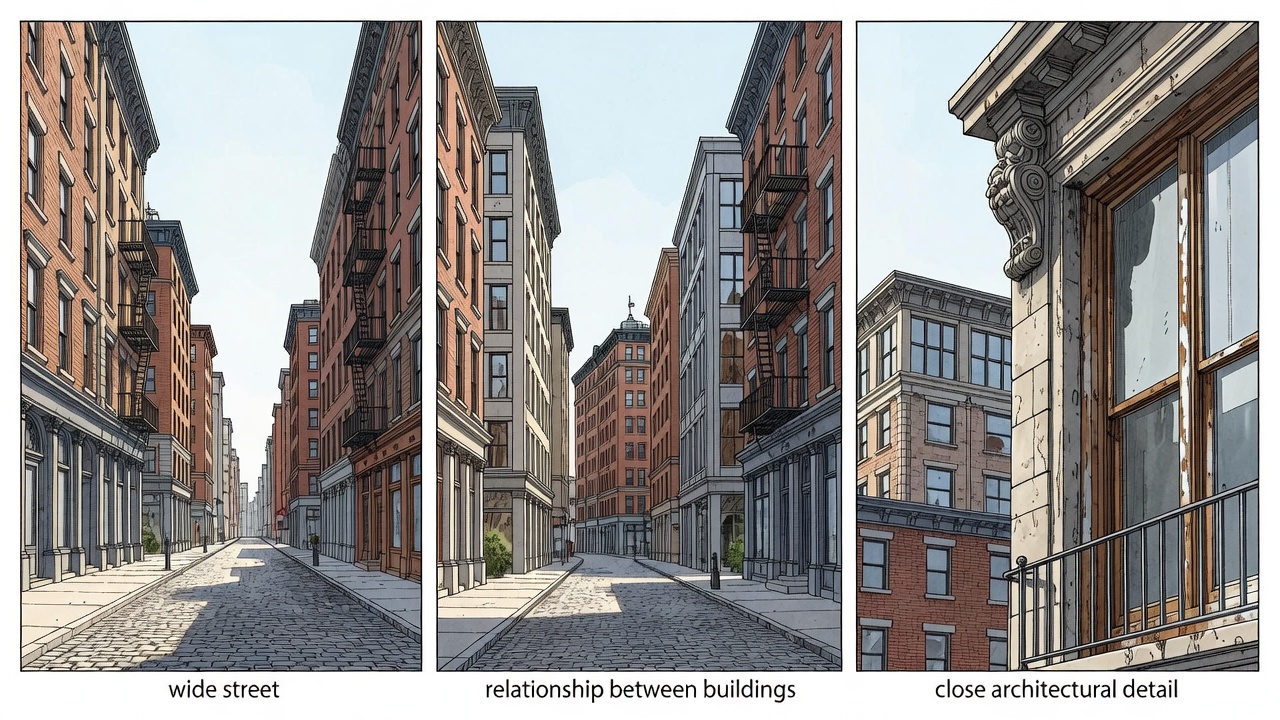
A city photography project does not need a rare location. It needs a reason for one image to sit beside another. Try asking how a street changes at its corners, how repaired surfaces reveal maintenance, or where shade meets places to rest. A question gives you a way to select pictures without turning the walk into a hunt for visual trophies.
Choose equipment you already know. A phone is enough for the exercises here, and a small notebook can be more useful than another lens. Clean the lens, check the battery and leave enough storage for a deliberate walk. Set up your camera before reaching a busy crossing so you are not solving a technical problem in someone else’s path.
Exercise one: a corner in three frames
Find a corner with a safe public viewpoint and make a wide image that explains the setting. Include the relationship between the buildings and the street rather than trying to fit everything into the frame. Keep an eye on the edges: a cropped crossing or a distracting vehicle may change what a viewer thinks the image is about.
Make a second image about a relationship. It could show a new shopfront beside an older entrance, a tree casting shade on a bench, or a ramp meeting a pavement. This is not simply a tighter version of the first photograph. It should make the project’s question easier to understand.
For the third image, choose a detail that adds evidence: a repaired joint, a sign mounting or a worn step visible from your permitted position. Do not enter a doorway, lean across a boundary or photograph through a home’s window to complete the sequence. If the detail cannot be made respectfully, find a different subject or leave the sequence unfinished.
Exercise two: return without chasing
Pick one viewpoint you can revisit safely and describe it well enough to find again. Note the direction you faced, the approximate framing and the conditions. A repeat photograph is most informative when the viewer can distinguish changes in the place from changes in your technique.
Try contrasting overcast and sunny conditions, or compare a leafless tree with the same view in leaf. Be precise about what changed. A quieter frame does not prove a street has become less popular; it may simply record a different time or a brief gap in activity. Avoid tracking identifiable people or building a record of residents’ routines.
Repeat photography has a long documentary history. Eugène Atget’s photographs of Paris and Berenice Abbott’s Changing New York can prompt questions about viewpoint and urban change. Look at their framing and captions critically, and remember that an influential photograph is still a selected view rather than a complete account of a place.
Make the next image answer the first one.A sequencing prompt, not a rule about what a city should look like
Edit for relationships, not spectacle
Back at home, make a small contact sheet or arrange thumbnails on screen. Remove duplicates before choosing favourites. Ask what each image contributes: context, contrast, evidence or a transition. If two pictures do the same job, keep the clearer one. Do not include a weak image solely because reaching the viewpoint took effort.
Keep edits honest about the purpose of the work. Adjusting exposure or colour for legibility is different from removing a structure or adding activity. If a project is presented as documentary observation, do not make material changes that alter its meaning. If an image is a creative composite, label it clearly rather than allowing a viewer to mistake it for a record.
Write captions while your notes are fresh. Include a broad location when it helps, explain the visible subject and identify any relevant uncertainty. Do not invent motives for people who appear in the frame. Where a person is the main subject, seek meaningful permission and consider whether publication could expose them to unwanted attention.
Review what the sequence reveals
Before sharing, enlarge every frame and inspect the background. Look for faces, children, vehicle registrations, entry systems, documents and views into private rooms. Crop, choose another image or withhold the photograph where the detail is unnecessary. A technically legal image can still be inconsiderate or disproportionate to the project’s purpose.
Check exported files for embedded location information. Removing a visible street sign does not necessarily remove GPS metadata, and a distinctive building can still make a place identifiable. Do not publish precise locations for vulnerable sites or directions that encourage unauthorised access. Describe the photographic method instead when the location itself is not essential.
Finish with a short project statement: your question, the scope of the walk, the limits of the evidence and what you would explore next. There is no need to pretend that a small sequence speaks for an entire neighbourhood. Our site does not host image uploads or public portfolios; use the note builder to prepare a text observation, and read the responsibility guide before planning another visit.