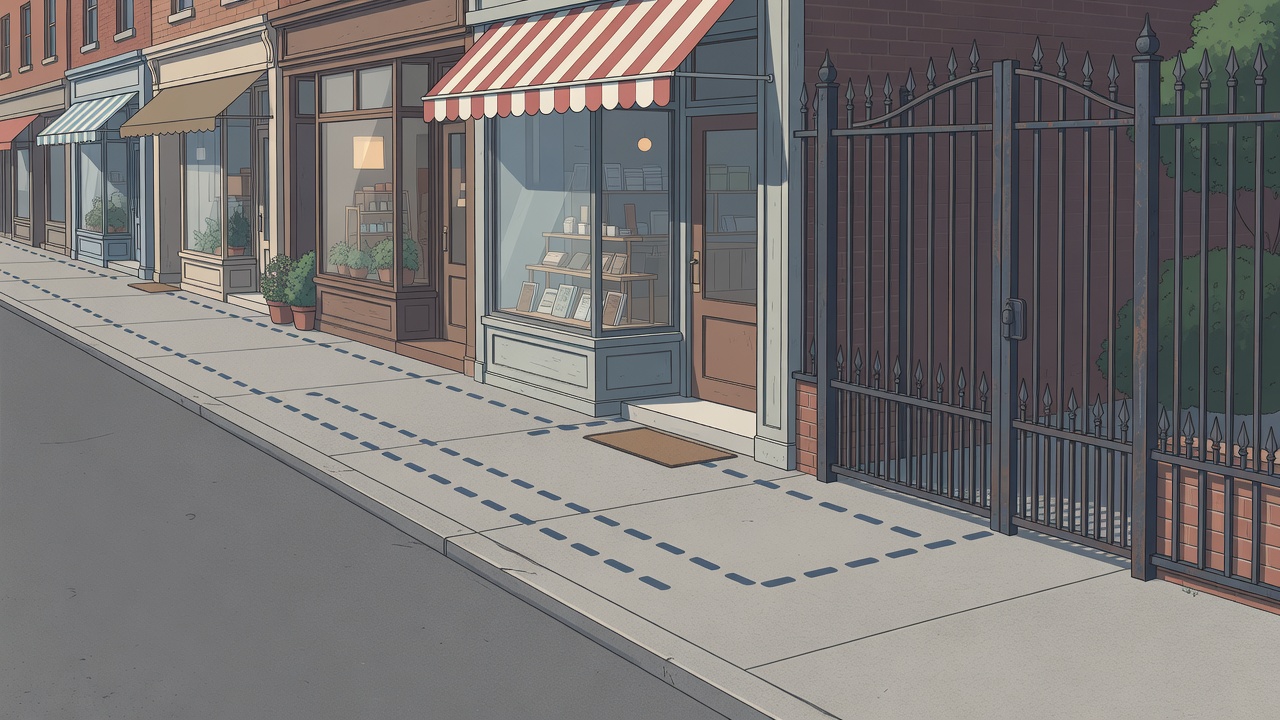
Urban exploration can mean attentive walking through ordinary public places. On this site it never means bypassing a fence, entering an abandoned structure or discovering how to evade security. A building can look unused while remaining owned, occupied, dangerous or important to someone’s daily life. Its appearance does not grant permission to enter.
Our approach is deliberately simple: use lawful, permitted routes; respect the people already there; and accept that some photographs should not be made. Laws and property arrangements vary by location. This guide cannot determine your rights at a particular site, and a photograph or article on the internet cannot establish current access conditions.
Check permission before the viewpoint
Distinguish a public street from a place that merely looks public. Courtyards, shopping passages, station concourses and estate roads may be privately managed or subject to specific conditions. Check signs and current information from the owner or operator. A gate being open, another visitor entering or an old post describing access is not sufficient evidence.
For an organised visit, obtain permission from someone authorised to give it and confirm what it covers. Ask about photography, equipment, permitted areas, timings and any restrictions on sharing images. Permission to enter a reception area does not extend to a roof, service corridor or neighbouring building. If terms are unclear, ask or leave the uncertain area out of your plan.
Do not climb barriers, test doors, enter construction works or use drainage, rail or utility infrastructure as routes. Do not seek access codes or publish ways around controls. A hard hat, high-visibility clothing or a camera does not make you authorised. Where a place is closed or access cannot be confirmed, the responsible alternative is a public exterior view or a different location.
A small checklist before each walk
- I have a permitted route and will not rely on an open gate.
- I have checked current opening information and local conditions.
- I can stop and photograph without blocking movement or entrances.
- I have a simple return plan and will change it if conditions worsen.
- I know which personal or location details should not be shared.
- I am comfortable returning without the photograph.
Plan around your own needs and those of anyone walking with you. Consider daylight, weather, accessible surfaces, water, a charged phone and a realistic distance. Share an ordinary outing plan with someone you trust when appropriate. Do not let a checklist create false confidence: it cannot make unstable structures, active works or restricted infrastructure safe to explore.
Leave residents room to live
A neighbourhood is not a set waiting for visitors. Keep away from private windows, leave doors and driveways clear, and avoid gathering a group where people need to pass. Do not move objects for a composition, ring doorbells merely to obtain a better angle or treat someone’s home as a curiosity they are obliged to explain.
If a person asks what you are doing, answer calmly and plainly. If they do not want to be photographed, respect that request. Legal rules about photography differ, but courtesy does not need to wait for a legal argument. For portraits, explain the intended use and ask permission without pressure. Be especially cautious with children, vulnerable people and situations involving distress.
Leave with a question, not with someone else’s privacy.Our approach to responsible observation
Treat publication as another access decision
Before sharing a note or image, ask what someone could do with the information. A broad description of a facade may be useful; a precise route to a weak boundary is not. Exclude codes, security arrangements, private addresses, identifiable routines and sensitive location metadata. Removing a name does not guarantee anonymity when a face, doorway or caption supplies the missing context.
Never advertise a site as “easy to get into,” “unguarded” or “secret.” Such descriptions encourage visits that can harm people and places even when the author intends only to be helpful. Explain how you observed responsibly instead: a public viewpoint, an authorised tour or a source-based history. If the exact location adds risk without adding understanding, leave it out.
Know when to stop
Move on if you cannot keep a clear route, if conditions become uncomfortable or if permission is withdrawn. Do not argue your way into a photograph. If you encounter an immediate danger, move to a safe place and contact the appropriate local emergency service; this website is not monitored for urgent help. Do not enter a hazardous area to inspect or document the problem.
For non-urgent maintenance concerns, use the relevant authority’s or property operator’s official reporting channel rather than publishing a vulnerable location. Our contact tool is for preparing editorial observations and corrections, not incident reporting. Thoughtful city discovery should leave the next person with a better understanding of a place, not a new reason to feel exposed.